
Here's the quick jump menu
I still remember the first time a customer handed me a “diamond” that turned out to be cubic zirconia. She'd bought it at a flea market. No certificate, no return policy. One look through my 10x loupe — the one I've carried for eleven years — and the double refraction gave it away. That little lens saved her from a very awkward conversation.
So what is a jeweler's loupe? In plain terms, it's a small magnifying lens — usually folding — that lets you inspect gemstones, hallmarks, and jewelry settings up close. But the real answer runs deeper. It's the cheapest tool that separates a guess from a fact.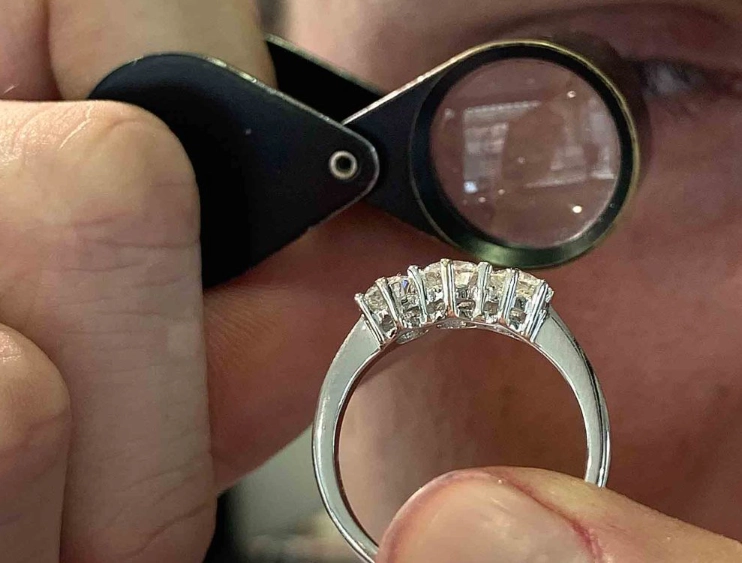
What a Jeweler's Loupe Actually Is (and Isn't)
A jeweler's loupe is a convex lens mounted in a frame, typically with 10x magnification. Most fold into a protective metal or plastic casing. You hold it close to your eye, bring the stone to about an inch from the lens, and focus by moving the object — not the loupe.
Here's where beginners get confused: a loupe is not a microscope. It won't zoom to 100x. It won't photograph anything. And a “jeweler's loupe” sold at a craft store for two dollars is often a coin loupe with poor edge sharpness — fine for reading dates on coins, useless for spot inclusions in a sapphire.
Non-consensus take: Most loupe guides tell you to buy a triplet (three-lens) loupe for the best color correction. I disagree for beginners. A good doublet with anti-reflective coating performs nearly as well for stone ID, costs half as much, and the wider field of view makes it easier to actually find inclusions. Save the triplet for appraisal work.
Why 10x Magnification Matters More Than 30x
Walk into any jewelry supply site and you'll see 20x, 30x, even 60x loupes. They sound impressive. They're mostly a trap.
Standard gemological grading — the kind defined by the Gemological Institute of America (GIA) — uses 10x magnification as the benchmark for clarity grading. A VS1 diamond at 10x looks clean. At 30x, you'll see clouds that don't affect the grade at all. Higher magnification also shrinks the field of view and cuts depth of field, so you spend more time hunting for the stone than actually examining it.
I tested this last summer with three loupes on the same 0.75-carat emerald-cut diamond. The 10x showed a small feather near the girdle. The 30x turned that feather into a confusing mess of internal graining that looked worse than it graded. The 10x was the honest lens.
| Magnification | Best Use | Field of View | My Verdict |
|---|---|---|---|
| 10x | Clarity grading, hallmark reading, inclusion mapping | Wide | Buy this first |
| 20x | Checking settings, prong wear | Moderate | Okay as a second lens |
| 30x | Lab work, photographing inclusions | Narrow | Skip unless you're an appraiser |
| 60x | Coin and stamp inspection | Very narrow | Not for gemstones |
How Do You Use a Jeweler's Loupe Correctly?
Almost everyone holds it wrong the first time. I did too. Here's the sequence that actually works:
- Step one: Hold the loupe in your dominant hand, close to your eye. Rest the rim gently against your cheekbone for stability.
- Step two: Bring the stone toward the loupe — not the other way around — until it sharpens into focus.
- Step three: Use a light source behind you, not directly on the stone. Direct light creates glare that hides surface-reaching inclusions.
- Step four: Rotate the stone slowly. Look for changes in color, sharp facet junctions, and internal reflections.
A mistake I see constantly: people squint through the loupe with the other eye open. That's fine if you're comfortable, but it doubles the visual input and makes focusing harder. Close the unused eye or cup your hand around it.
Warning: Never clean a loupe lens with your shirt. Dust particles in fabric micro-scratch the coating. I've seen a $60 triplet ruined in one wipe. Use a microfiber cloth and lens fluid only.
What Can You Spot Through a Loupe?
This is where the loupe earns its keep. With a 10x lens and decent lighting, you can identify:
- Inclusions in diamonds — crystals, feathers, clouds, and pinpoint clusters. A loupe clean diamond (no inclusions at 10x) sits in the VVS range.
- Double refraction in moissanite and zircon — the back facets look doubled when you tilt the stone. That's a fast way to separate diamond from its lookalikes.
- Hallmarks on gold and silver — a 10x loupe lets you read tiny maker's marks and purity stamps that are invisible to the naked eye.
- Prong wear and loose stones — you'll see gaps between the prong tip and the stone before the stone falls out.
- Surface-reaching fractures — these weaken a stone and often show up as bright reflective lines under the loupe.
One client brought in an “emerald” ring she'd inherited. Through the loupe, I saw gas bubbles and curved striae — telltale signs of glass. She wasn't upset. She said, “At least now I know what I'm passing down.” That's the loupe's real value: it gives you the truth before you make a decision.
How to Choose Your First Loupe Without Overpaying
You don't need a laboratory-grade triplet to start. Here's what I recommend after handling dozens of models:
- Magnification: 10x. Stick to it.
- Lens type: Doublet with anti-reflective coating. Triplet if you plan to appraise.
- Body: Metal frame with a swing-away case. Plastic frames crack in pockets.
- Field of view: At least 18mm. Smaller than that and you'll feel like you're peeking through a keyhole.
- Price range: $15 to $40 for a solid beginner loupe. Above $60 and you're paying for lab certification that doesn't improve your stone ID skills.
Skip the loupes with built-in LED lights. They seem handy, but the light angle is fixed and often creates glare exactly where you don't want it. A separate penlight gives you control.
Loupe Questions People Actually Ask
My loupe shows every tiny scratch on my ring — is my diamond damaged?
A 10x loupe reveals surface abrasions that are completely normal on a worn ring. Diamonds are hard, not indestructible. If you see scratches only on the facet junctions and not across the table, it's routine wear. A professional polish can restore it. Don't panic until you've looked at the stone under a gemological microscope.
Can I use a jeweler's loupe to check if a pearl is real?
Yes, and it's one of the fastest tests. Real pearls show a slightly rough, overlapping nacre surface under 10x — like tiny roof tiles. Faux pearls look glassy and smooth, sometimes with peeling edges near the drill hole. I've caught more fake pearls with a loupe than with any other tool.
Why does my 10x loupe make the stone look blurry at the edges?
That's field curvature, and it's common in cheap single-lens loupes. The center focuses but the edges don't. A doublet or triplet corrects this. If you're serious about stone ID, return the single-lens model and spend ten more dollars on a doublet.
How do I read a gold hallmark through a loupe if the mark is worn?
Angle the loupe so the light rakes across the mark at a low angle. Worn hallmarks cast tiny shadows that reveal the original stamp. I've read marks that looked completely smooth under direct light by shifting my penlight to the side. Patience beats magnification here.
The jeweler's loupe is one of those tools that seems too simple to matter. Then you use one on a stone you're about to buy, and suddenly the extra twenty dollars feels like the best money you've spent all year. Mine lives in my jacket pocket. It's been to estate sales, pawn shops, and one very questionable flea market in July. It hasn't failed me yet.
This article was fact-checked against gemological grading standards and firsthand tool testing.
Comments
Leave a Comment