
I still remember the first time I saw a ruby glow like a hot coal under a longwave UV lamp. The dealer next to me shrugged. "It's just fluorescence," he said. But that glow—and the fact that some stones show it while others stay dead dark—tells a story that most buyers never hear. Gemstone fluorescence isn't a defect or a magic trick. It's a diagnostic clue that can save you from a bad deal or reassure you that the stone you love is exactly what the lab says it is. Let me walk you through what I've learned from years of peering at gems under UV light.
- What is gemstone fluorescence, really?
- How to use UV light for gem testing without fooling yourself
- Why fluorescence in diamonds and rubies matters (and when it doesn't)
- Red flags: when chalky fluorescence should make you walk away
- A case study: the sapphire that looked too good under UV
- Questions I hear at the bench
What is gemstone fluorescence, really?
Here's the short version. When you shine a UV lamp on certain gems, electrons in trace elements (like chromium in ruby or nitrogen in diamond) get excited and then release that energy as visible light. This happens only under UV, not under regular room light. The color and intensity of that glow vary wildly.
I've had customers ask if fluorescence means the stone is synthetic. Absolutely not. Many natural stones fluoresce. Some synthetics don't. The trouble is that people either ignore fluorescence completely or treat it like a death sentence. Both extremes are wrong.
Take a quick look at this reference table. I keep a laminated version in my toolbox.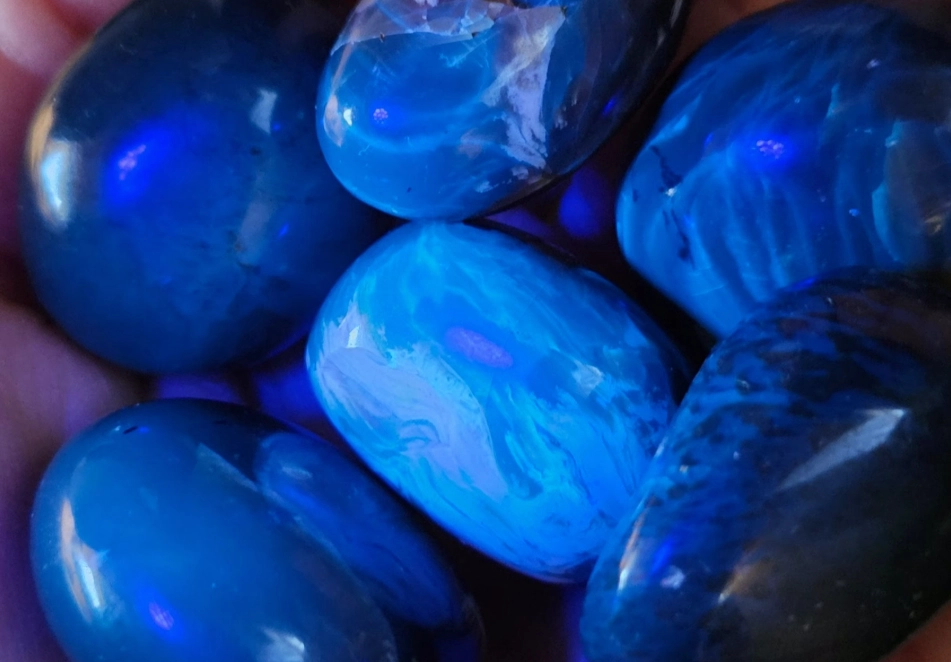
| Gemstone | Typical Fluorescence under Longwave UV | What it often indicates |
|---|---|---|
| Ruby (natural) | Strong red to pink glow | Chromium presence; helps separate from some synthetics, but not definitive alone |
| Sapphire (natural, blue) | Usually inert or weak greenish | Strong chalky blue-white often hints at heat treatment or synthetic |
| Diamond (natural) | Blue glow (usually faint to medium) | About 25-35% of diamonds show blue fluorescence; can cause hazy look in strong sunlight |
| Emerald (natural) | Often inert; some show weak green | Strong fluorescence is rare and may suggest synthetic or treatment |
How to use UV light for gem testing without fooling yourself
I've seen people buy a cheap UV flashlight and immediately misjudge a stone. The wattage, the wavelength (longwave vs. shortwave), even the distance from the stone all change the results. Here's my three-step walkthrough for a clean test at home.
Step 1: Get the right lamp
For gemstone fluorescence, longwave UV (365 nm) is what most labs use. Shortwave (254 nm) is more hazardous and rarely needed for basic checks. A pocket-sized 365 nm flashlight costs around $20–40 and works fine. I use a UV Beast V3, but any decent 365 nm model will do.
Step 2: Control the environment
Do this in a dark room with no windows. Wait a minute for your eyes to adjust. Place the stone on a black cloth or a matte surface. The glow can be weak, and stray light kills the contrast.
Step 3: Compare and record
Don't just look at the stone in isolation. Have a known reference stone (a small natural ruby or a diamond with known fluorescence) next to it. Take a phone photo. The camera sensor might exaggerate or downplay the glow, so use it for documentation, not for final judgment. I learned that one the hard way after swearing a sapphire was inert, only to find later that my phone's auto-white balance was hiding a faint chalky glow.
Why fluorescence in diamonds and rubies matters (and when it doesn't)
The diamond world has a love-hate relationship with fluorescence. A strong blue glow under UV can make a diamond look milky or hazy in daylight—some buyers call it "overblue." But here's the part they don't tell you: on the GIA grading scale, fluorescence is noted but rarely affects color grade. I've seen stones with medium blue fluorescence that face up perfectly white. And I've seen faint fluorescence stones that look duller.
For rubies, fluorescence is more about origin and treatment. Burmese rubies often show strong red fluorescence. Thai rubies are usually inert because of high iron content. If someone tries to sell you a "Burmese ruby" that doesn't glow at all, ask questions. It might still be Burmese, but the iron content tells a different story.
Here's a quick comparison I keep in my notebook:
| Gem origin / type | Fluorescence behavior | Practical takeaway |
|---|---|---|
| Burmese ruby (natural, untreated) | Strong red | Expected; consistent with origin but not a guarantee |
| Thai ruby (natural) | Inert or very weak | High iron content; don't confuse with synthetic |
| Synthetic ruby (flame fusion) | Very strong, even red | Suspicious if the glow is too uniform |
| Natural blue sapphire (unheated) | Usually inert | Chalky blue-white glow suggests heat treatment |
Red flags: when chalky fluorescence should make you walk away
I once inspected a beautiful blue sapphire at a gem show in Tucson. The seller swore it was unheated. Under my UV lamp, it lit up with a chalky, milky blue-white glow that looked like someone had smeared white paint on the surface. That's the classic signature of a sapphire that's been heated with borax—the flux residues can cause that chalky fluorescence. I passed on the stone and told the seller why. He didn't argue.
Another red flag: a diamond with very strong blue fluorescence combined with a hazy appearance. Not always a dealbreaker, but if you're paying for a high-clarity stone, that haze can dull the sparkle. I recommend viewing such stones in natural daylight, not just under jewelry store lights.
One more thing—emeralds can be tricky. Many emeralds are treated with oils or resins. Some of those treatments fluoresce a faint greenish or whitish color under UV. If you see a glow that seems to come from the fractures rather than the bulk of the stone, that's a strong hint of treatment. I always note that when I document a stone.
A case study: the sapphire that looked too good under UV
Last spring, a client brought in a 2.1-carat blue sapphire she'd inherited. She wanted to know if it was worth insuring. Under my 365 nm lamp, the stone showed a distinct chalky-yellowish fluorescence in patches. That pattern didn't match typical heat treatment. I sent it to a lab for a full report. Turned out it was a synthetic sapphire made by the Verneuil process, and the fluorescence came from trace elements in the growth layers. My UV check saved her from insuring a synthetic as a natural stone—a difference of several thousand dollars.
The lesson: fluorescence alone doesn't identify a stone, but it raises flags that tell you when to dig deeper.
Questions I hear at the bench
My diamond has strong blue fluorescence. Is it worth less money?
Not automatically. The market discounts strongly fluorescent diamonds mainly when the fluorescence causes a hazy or oily look. For stones with VS clarity or better, that haze can be noticeable. But for lower clarities (SI1 or below), strong fluorescence can sometimes make the stone look slightly better by masking yellow tint. My advice: look at the stone in daylight. If it looks fine to your eye, the fluorescence is just a footnote on the report.
Can I use a blacklight to spot fake gemstones?
You can spot some inconsistencies, but a blacklight is not a fake detector. Many synthetics fluoresce exactly like natural stones. Some natural stones are inert. Use fluorescence as one data point—not the final word. If a deal seems too good, send the stone to a lab. A $150 lab report is cheaper than a fake ruby.
Why does my ruby glow in sunlight but not under my UV lamp?
Sunlight contains a small amount of UV, but the UV intensity is much lower than a dedicated lamp. Also, many rubies have strong chromium fluorescence that is excited by violet light as well as UV. If your lamp is weak or the wrong wavelength (like a cheap 395 nm flashlight), you might miss the glow. Try a 365 nm lamp in a dark room—if it still doesn't glow, the ruby might be iron-rich (like Thai material) or synthetic with no fluorescence.
Is fluorescence ever a good sign in emeralds?
Generally, strong fluorescence in emerald is uncommon and can indicate synthetic origin or treatment. Natural emeralds from certain locations (like Zambia) might show weak green fluorescence, but it's usually subtle. If you see a bright, even glow, be suspicious—ask for a lab report from a reputable gem lab like GIA or AGL.
Comments
Leave a Comment